Nick Offerman, Come On Down!

Nick Offerman

You probably know Nick Offerman from NBC’s Parks and Recreation, though if you’re a maker, you may know him better for his woodworking skills. (There’s a great video tour of his workshop you should see.)

Well, Nick’s coming to Milwaukee February 23rd, 2013 for a show at The Pabst Theater, and while we’re sure he’s a busy man, we’d like to invite him to Milwaukee Makerspace to check out our workshop. We’ve got a nice collection of tools and a great group of makers who would love to show Nick some of the things we’ve made and talk about our love of wood.

Check out Offerman Woodshop for some of his amazing work, and if you’re on Twitter, ask @Nick_Offerman to swing by Milwaukee Makerspace and check it out!

Shipping Greatness Book Review

Here’s a book review for the MMS Book Club. A copy of this book is in the Milwaukee Makerspace’s library.

Chris Vander Mey was a Google product manager and an Amazon engineering manager. Shipping Greatness is a handbook on how to that job. It may have different titles, the book lists a bunch, but Mey is describing a specific job in a specific type of organization. The job is project manager. The project is a new website or website feature. The organization is a large enough company to have multiple teams working on different projects of this type. The team will report to management higher up the corporate ladder.

The book assumes the product team, as part of a larger organization, has plenty of available resources. For example teams will have multiple design contributors, user experience, user interface, visual designers, etc. Mey doesn’t assume these will all be distinct individuals, nor that these will be dedicated to the team for the duration of product development. Yet he does assume the team will have access to such contributors. Having a full time project manager on a team presupposes a sizeable team.

The products Mey shipped were mostly websites or website features. Mey gives specific advice on how to project manage the production of this specific product type. Mey fails to generalize his lessons, so that the reader can easily apply his advice to other situations. It’s an exercise for the reader to figure out how to apply this advice to contract programming projects or native mobile apps.

Unfortunately I do not have that job. I work on a much smaller team, where we don’t have a product manager per se. Most members of the team share the responsibilities and contributions Mey describes. Mey’s book is laser focused on the project manager’s contribution to shipping product, so it doesn’t translate to my team. I’m able to apply very little from this book to my situation.

If you have this job, or want this job, read this book. If you work on a team like this and want to understand your project manager, read this book. Those of us working in a different team structure can skip this book.


88nine Lazzored!

Radio Milwaukee Lazzored!

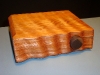
I used the laser cutter to make a Raspberry Pi case, and rather than leave the front of it all boring, I added an 88nine Radio Milwaukee logo to it. (Since I had a project that involves a Raspberry Pi and 88nine, it seemed appropriate.)

Radio Milwaukee Logo

I started with the original 88nine logo, which is brown and orange. I couldn’t find a nice hires version, but a quick web search turned up something that would work…

Radio Milwaukee Logo

To start with, I converted the logo to black and white, since color wasn’t going to matter to the laser cutter…

Radio Milwaukee Logo

I then separated the top bars (which are orange in the original logo) and dithered them to create a visual separation from the bottom part of the logo that was brown in the original.

Radio Milwaukee Logo

Here’s a close-up of the dithering pattern. It’s extremely simple, but it worked. I’ve done a lot of work with halftones and dithering, and you can get extremely complex, but sometimes the simple things just work.

Radio Milwaukee close-up

Here’s a close-up of the final piece of Baltic Birch plywood with the logo etched in it. I’m pretty happy with how it turned out.

Time Lapse Bot on Watch

Time Lapse Bot

With Milwaukee Makerspace still in a state of constant change, I thought that Time Lapse Bot might enjoy keeping an eye on things…

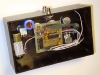
Time Lapse Bot consists of an old laptop running (an older version of) EvoCam to capture an image every X number of minutes or seconds.

Time Lapse Box

The whole thing fits in a nice box that you can easily carry around and place on a table or other flat surface to capture images. You’ve probably seen Time Lapse Bot at various BarCamp events around Milwaukee.

Time Lapse Bot + Base

Eventually carrying Time Lapse Bot around looking for something to set it on got tiresome, so I built a rolling base from an old office chair. We also upgraded the camera over time, starting originally with an old VHS camera with a USB adapter, then moving up to a MiniDV camera with FireWire, and now a Logitech C910 Webcam, which captures HD quality images. (We also recently added a gooseneck for easier camera positioning, and a bit of height, as you can see in the top photo.)

There’s a heap more info about Time Lapse Bot over on my web site… and if you remember the Red Lotus build from last summer, or the Grand Opening at Chase, yeah, those were done with Time Lapse Bot.

February Electric Car Club

Electric Car Club

Did you know that we’ve got a number of members who have built electric cars? Ben Nelson even runs 300mph.org and has published DVDs and Instructables showing you how to build your own. (Sharing of knowledge is a top priority for our members!)

If you’re interested in electric cars, come on down to Milwaukee Makerspace at 1pm on Sunday, February 10th, 2013 for the first Milwaukee Electric Car Club Meeting at our new location. Got a Tesla, or a Volt, or some DIY/converted vehicle? Bring it! Just want to learn what these electric vehicles are all about? That’s cool too!

The Milwaukee Electric Car Club: Because gasoline is so 20th century.

BrownDogGadgets

BrownDogGadgets

I first came across BrownDogGadgets on Etsy back in 2011, and was excited to see a kit-maker in Milwaukee. Somehow I never managed to connect with the man behind BrownDogGadgets until recently when we somehow became friends on Facebook, and I then realized that Joshua was the driving force behind BrownDogGadgets.

BrownDogGadgets makes a variety of fun electronics kits, many of which center around solar energy, and many of which fit in empty Altoid tins. (There’s also some Arduino-compatible kits which look pretty interesting.)

We’re glad to have Joshua as a new member of Milwaukee Makerspace and look forward to having someone with kit-making skills in the group.

Check out browndoggadgets.com for some awesome kit fun!

Water, Water…

Water!

We had to pause a bit last night when we saw some water in the space… Our old location at Chase was well known for the leaky roof and the occasional floods. It turns out the water was just from the electrician’s truck that was pulled into the space. Whew!

The Lenox building has been water-tight so far (knock on MDF!) and we’re feeling secure in the fact that everything that should stay dry will stay dry.

Kevin also demanded I take an “arty” photo of the water. Enjoy!

A Clockwork…Room Divider

A 6 foot tall, clockwork gear inpired, tri-fold room divider

Hopefully, we can use this as a backdrop for events like the Art Jamboree.

I’ve been toying with the idea of room dividers for a while now. I don’t exactly have use for one, but I think they look neat and it’s basically a blank canvas. Drawing inspiration from my Clockwork Boxes, I decided that a gear motif would best suit the makerspace, thus giving me a new use for the piece: as a backdrop at events we participate in such as Art Jamboree and the various Maker Faires.

A picture of myself, Jason, and Matt, standing around the room divider

There are 3 of us in this photo. Really.

The actual screens were cut out with a large-scale CNC router, while the frame was ripped from 2×4′s, with a dado groove down the center for the screen to slip into. Thanks, Jason H.!!

Assembly went well, although there were a few hiccups.  The drill bit wasn’t long enough, so some minor splitting occurred at a couple of spots. The frame was slightly warped and so needed to be clamped and glued before being screwed together.

After allowing the paint to dry overnight, myself, Matt W., and Jason H. assembled this thing just prior to heading to the Art Jamboree at the Hilton in Milwaukee.

EDIT: I’ve just entered this into the Furniture Contest that Instructables is running. Click the link. Vote. Be thanked. :)

LEGOlamp

LEGO_lamp_2_complete_dark   This is the assembled LEGOlamp.  It will be mounted as a ceiling fixture, with an internal bulb.  To light it for this picture, I used a desklamp to project light into the tube.

One idea I tried after the previous post, was slicing the tube into 16 rings.  The idea was to glue the bricks to the tube, with the bricks stacked vertically, then offset the rings after the bricks were attached.  That approach failed.  I was unable to cut the rings smoothly, resulting in large gaps between them.  When stacked, they looked horrible.

In the end, a simple change of adhesive and application made the difference.  First, I abandoned both hot glue and epoxy.  I discovered gel super glue has sufficient open time to position the bricks, but also sets quickly enough that clamping and supporting the bricks was unnecessary.  I addition, I realized the important joint is between the bricks.  If the bricks are firmly cemented to each other, the connection to the tube can be a series of comparatively weak joins.  Less glue on the end-face means less glue to smear, and less chance of accidentally gluing the template in place.


drillpress_dremel_saw  Many people have asked how I cut the LEGO bricks.  Initially, I used a sharp chisel.  That was tedious, as each brick had to be clamped.  After that, I switched to a rotary-tool held in a fixture, with a standard abrasive cut-off disk.  That worked well enough.  Finally, I hit on chucking a Dremel-sized circular saw blade into a drill press.  That provided a rock-solid platform.  Better still, once the height was set it didn’t vary.  Unlike the abrasive disk, the bricks weren’t heated by the saw blade.  No molten plastic flying around.  Using this method, the bricks required little-or-no touch-up work with a sharp knife.

We’re Back!

OPEN!

You’ve been waiting for it, we’ve been waiting for it… Milwaukee Makerspace can now officially re-open, and we’ll be holding our first official meeting of the year at 7pm on Tuesday, January 29th, 2013.

Come on down to 2555 South Lenox Street in Milwaukee, Wisconsin, and see the new Milwaukee Makerspace. It’s bigger, better and 178% more makier!

See you Tuesday!