To Boldly Go Where Many Spaces Have Gone Before!

As of mid-January, the Milwaukee Makerspace is now a member of the Space Federation. The Space Federation is an organization that brings hackerspaces and makerspaces together to share resources and knowledge, while providing non-profit fiscal sponsorship for member spaces.

Space Federation

With the fiscal sponsorship provided by the Space Federation, we will be able to accept tax-deductible donations of equipment and funds from individuals and corporations. We have already been approached by several companies and individuals about helping out the space and the new setup will help us do more for the community in Milwaukee. More importantly, a non-profit structure has always felt right for the space. We collect dues so we can provide an awesome space for the makers in our community. All of our officers and members volunteer their time to make the Makerspace great and no one profits from the space directly – if you discount inspiration and collaboration, that is. The new structure formalizes one of our guiding principles in a way that will hopefully help us do more for our makers and Milwaukee itself.

The discussion to become a non-profit has been an active one throughout our history. Joining up with the Federation gives us experienced folks to work with and a bit less work on our side. We’re excited by the opportunities for the space and the community the Space Federation provides … and we’re in good company! Many of our favorite spaces around the midwest and the country are already members of the federation and we’re excited to start working a bit more closely with them. It’s also nice to work with more local folks – the Federation is based here in Milwaukee.

Things are still getting set up, but if you are interested in working with us in our new capacity, please get in touch with our board!

Build Out In-Progress Pictures

We are super close to re-opening again. We can’t wait to see folks start using the new space. Members and Friends of the Space have been hard at work getting our new space ready for business again.

Even though we aren’t open yet, we’d like to share a couple shots of the space in progress. New Friend of the Space, Rodney, took a few excellent shots of the progress being made a few days ago. Thanks for helping out and thanks for the great shots, Rodney! We’ll have some more shots of things cleaned up a bit more shortly.

As much as we like photos, we are really anxious to open up our doors to Milwaukee again. Hopefully we’ll see you around the new space soon!

East Room exit aisles

We haven't found a home for all this stuff from Chase yet.

We haven’t found a home for all this stuff from Chase yet.

West Room looking into the East Room

This is where our car area and the machine shop will be.

This is where our car area and the machine shop will be.

This is where the bulk of the machine shop will be.

This is where the bulk of the machine shop will be.

Another Art Jamboree!

Art Jamboree!

It’s that time again, folks… Time for another Art Jamboree! Join us on January 25, 2013 from 7pm to 11pm at the Loyalty Building (Hilton Garden Inn) 611 N. Broadway, Milwaukee, Wisconsin.

The event is free and open to the public (and all ages are welcome) and there will also be a cash bar, prizes, art raffles, free hi-fives and some of your favorite Milwaukee Makerspace members showing off things they’ve made, many of which could be considered “art”!

We’ll also have some interactive pieces for you to experience, but we can’t give away all the details yet, because we’re all about secrecy and the element of surprise, so you’ll just have to show up and see what we do. (Safety glasses and ear plugs are highly recommended!)

Oh, and our friends at Art Milwaukee (who are putting on this event) have all the info on the Art Jamboree you’ll need. We hope to see you there!

We leave, we come back!

Leaves

Even though we left Chase Avenue and moved to Lenox Street, we’re still not a fully operational battle maker station… yet.

But here’s the thing, for a lot of us, we never stop making, and if someone needs help on a project, we’re still going to do what we can to help out. So when some friends of mine at Sensorium Gallery ask for help with a laser cutting project, we found a way to deliver.

They were looking for white paper leaves to cover the floor for an event, and had the idea of laser cutting a few reams of paper. I found a maple leaf on OpenClipArt, tweaked it a bit, and sent it to Neille at Sensorium. She sent me back a new file, and I gave that to Brent who has access to a laser cutter he could use while the Makerspace laser cutters were not up and running.

A few emails back and forth, and between the three of us we got the leaves done in time. Sweet! Once we return to “making as usual” it’ll be nice to help people out with their projects without having to chase people down and send a bunch of emails. I hope Bay View is ready for us! :)

Baltimore Hackerspace Visit


Baltimore Hackerspace

During a recent trip to Baltimore I got to visit Baltimore Hackerspace, take a quick tour, and talk to two of their members.

Our story actually starts back in 2011, when I was passing through Baltimore and tried to connect with Baltimore Node (another hackerspace in Baltimore) and when I mentioned on their mailing list I’d be passing through town, I got an invite to stop by Baltimore Hackerspace, which at the time was called “Harford Hackerspace” and was located in one of the member’s garage. Well, I never made it to either space last year, so I thought I’d try again this year… sadly, Baltimore Node does not currently have a space due to some issues with Load of Fun, the building they are located in. (Side note: I snapped a photo of Load of Fun back in 2009, before I was even a Milwaukee Makerspace member.)

Confused yet? Good! Anyway, Mike from Baltimore Hackerspace was kind enough to meet me there on a Wednesday afternoon for a tour. We talked about Power Wheels, Make Magazine, The Red Bull Challenge, how Baltimore Hackerspace operates, how Milwaukee Makerspace operates, and general making and hacking activities.

I snapped a few photos as well… enjoy!

Baltimore Hackerspace
Baltimore Hackerspace was not easy to find! It’s in an industrial unit (which looks a little like a storage unit) with no sign on the door. I think some signage is in their future, as it’ll really help new visitors find the place.

Power Wheels
Here’s their Power Wheels car. It looks unlike any other Power Wheels car I’ve seen. Like most Power Wheels cars, it occasionally starts on fire. :)

Telepresence Zen Garden
Here’s the “Telepresence Zen Garden” they built for the 2012 RedBull Creation Competition.

Robot Game
They had a robot game thingy, which was a little like Operation, but you had to guide a wand over the wire and not touch it, or the robot freaked out.

Recycle Robot
OK, this thing was impressive, and confusing. When I first saw this robot I assumed it was some commercially available unit, but it turned it was build using mostly scrap! Mark (the guy working on it) finds interesting pieces from children’s toys, household appliances, etc. and puts it all together. And, that weird thing to the right is indeed a walker, modified to assist the robot in walking, at least until it can walk on its own, without the help of a balancing mechanism. Great project!

Baltimore Hackerspace
There was also art to be found… I don’t know if this was done by a member, but it definitely added color to the space and let you know where you were. ;)

Space Invaders
Some Space Invaders were descending down the wall… I hope they fill the whole wall with them, it would definitely look cool.

Whiteboard
They had a small office for meetings, with a big table and chairs for hacking and what-not. The office also had this whiteboard, which may contain the secrets of the universe… or something.

MakerBot Thing-O-Matic
What’s a hackerspace without a 3D printer? Here’s their MakerBot Thing-O-Matic ready to melt some plastic.

Keyboard
Looks like they’ve also got some music fans (and maybe video nerds?) as members. I love the color bars!

Well, that concludes our tour of Baltimore Hackerspace… if you’re ever in Charm City, check ‘em out!

Digi-Comp Making

Digi-Comp II
Photo by Windell Oskay

I love a good blog post! And I really love a good blog post about the process of making things! From selecting the proper wood, to cutting, laser-etching, assembling, and packaging, this blog post has it all. I’m taking about The Making of the Digi-Comp II, First Edition from our friends at Evil Mad Scientist Laboratories.

There’s a great/amusing comment on the post:

When’s the official air date on “How It’s Made”? :D

It’s funny because it is a long and detailed post about the process of making something (disclaimer: I’m a fan of shows like How It’s Made) but I don’t think a maker version of How It’s Made is a bad idea! Hmmm, maybe that’s what the MAKE TV show is going to be.

MAKE

MAKE

Kevin did a great job updating Robert Indiana’s iconic sculpture “LOVE” into a piece he titled “FEAR”, and it inspired me to create something to give us hope in these dark times…

Rather than use a cold, harsh material like aluminum, I opted for something a little more comforting… plastic. Also, mine comes in a handy desktop version!

(See Also: The Making of MAKE.)

Iron Hooks from old Nails

Recently, I’ve started playing around a bit with metal-working. Pretty low-tech stuff – heat it and beat it.

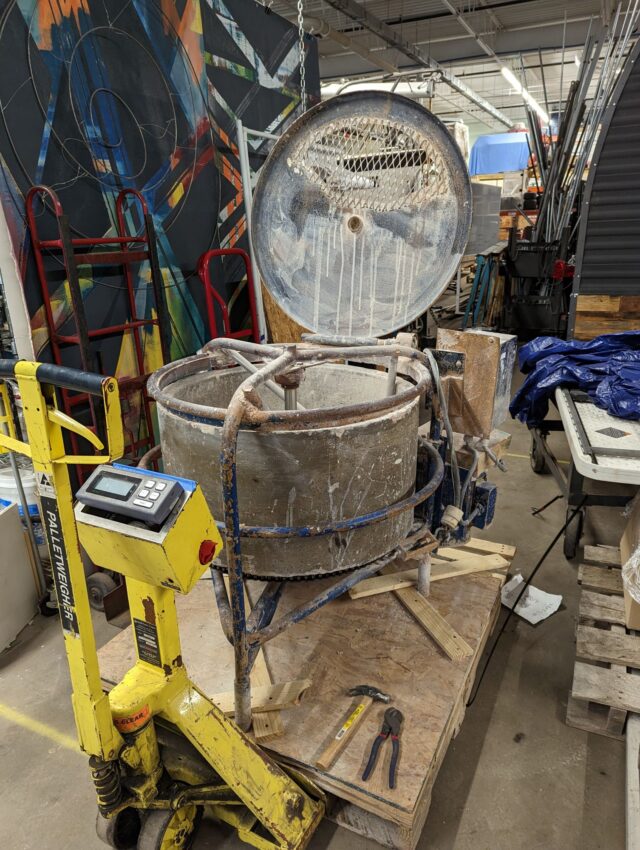
My DIY coal forge isn’t much to look at, just a couple pieces of steel pipe with the shop-vac on a dimmer switch, and an old brake disc welded on top, but it’s enough to do some basic blacksmithing.

Last night after work, I fired up the mini-forge and worked on a pair of old iron nails. I heated them, and then applied a blacksmith twist, a bend to make a hook, and even hot-punched (NOT drilled) mounting holes.

Once done, I hit them with a wire wheel to give it that shiny silver-and-black finish I like.

The result is a pair of decorative, yet very functional, iron hooks for hanging decorations, photos, and the like. Maybe I can make a few more to mount next to my wood stove to hold my fire poker and kindling hatchet.

Categorizing Projects

Friday Night Drawbot

I got invited to take part in a gallery show and display some of the art created by my art robots, and I must say, the whole experience reminded me a little bit of my time in the arts program at UWM. Late nights with X-ACTO knives, cork-backed metal rulers, foam core, spray glue, looming deadlines, things not working out as well as you’d like them to… repeatedly. Besides all that though, it was a lot of fun.

I tend to get distracted by other projects after I reach the stages of “it works!” and “I showed it to people!” and I’m not alone… many members of Milwaukee Makerspace suffer from this as well. We’re starting a support group. Actually, we started 5 support groups, but we keep getting distracted by other projects. (I kid, I kid!)

The thing I really like about projects that involve hardware and software is that you can work on one side for a bit, and then switch gears and work on the other side. Many of the makers I know write code all day (which they like doing) and do hardware stuff at night (which they also like doing) so combining them is a double-win.

Arc-O-Matic

I started thinking about some of my projects, and I think they fit into a few categories:

  1. Idea Only: These are projects where I come up with an idea but never follow through on them.
  2. Completed/Forgotten: Projects that get “done” and then I just move on from them without ever improving or creating new versions.
  3. Always in Progress: These are projects that are never finished. They may reach finished “stages” but there’s always a chance they’ll get upgraded, or completely rebuilt, or replaced with a better version.
  4. Failure: Things I try, that just don’t work out. They typically get abandoned.

You might think the Completed/Forgotten or Always in Progress projects are the best, but there’s a lot to be learned by the Idea Only and Failure projects as well. In the end, I love learning new things, so even if I don’t finish a project, learning something new, or even learning how not to do something, can be very valuable.

How do you categorize your projects?